If you spend any time around people who build AI, you will hear a phrase that sounds like jargon: "the model got stuck in a local minimum."
It is one of the most useful ideas in machine learning, and it has nothing to do with math once you see it. It describes exactly what happens to most marketing sites after a year of optimization. You tweak, it gets a little better, you tweak again, it gets a little worse, you put it back. Eventually nothing you try beats what you have. That feels like you found the best page. Usually you found a best page.
Training an AI is walking downhill in the fog
When an AI model learns, it starts out bad at its task. Engineers measure how bad with one number, called the loss. A high loss means lots of wrong answers. A low loss means few. Training is the process of pushing that number down.
Picture the loss as a landscape of hills and valleys. Every possible setting of the model is a spot on the map, and the height of the ground at that spot is how wrong the model is there. Training wants the lowest point on the whole map.
The catch: the model can't see the map. It is standing in thick fog. All it can feel is the slope under its feet. So it does the only sensible thing. It takes a step downhill. Then another. This is called gradient descent, and nearly every modern AI is trained this way.
Walk downhill long enough and you reach a spot where every direction goes up. You are at the bottom of a valley. That is a minimum.
Here is the problem. You might be at the bottom of a small valley high up a mountainside, while the deepest valley on the map is a mile away. From where you stand, every step goes up, so walking downhill will never get you there. That small valley is a local minimum. The deepest valley anywhere is the global minimum.
Note
Local minimum: a spot where every small step makes things worse, but which isn't the best spot overall. Global minimum: the best spot on the whole map. Small steps alone can't tell the two apart.
AI researchers have a few standard ways out:
- Take some random steps. A bit of noise in each step can bounce you out of a shallow valley.
- Start from several places. Drop walkers in different parts of the map and keep the best one.
- Take bigger jumps early. Big moves at the start explore the terrain; small moves later fine-tune.
Every one of these trades a little short-term progress for a better chance of finding the deep valley. Keep that in mind. It is the whole lesson.
Your conversion rate has the same landscape, upside down
In marketing you want a number to go up, not down, so flip the picture. The landscape is your conversion rate, the ground is hills instead of valleys, and you are climbing. The trap is a local maximum: a small hill where every nearby change converts worse, while a much taller hill sits somewhere you haven't been. Same idea, same trap. People use "local minimum" and "local optimum" loosely for both, and so will we.
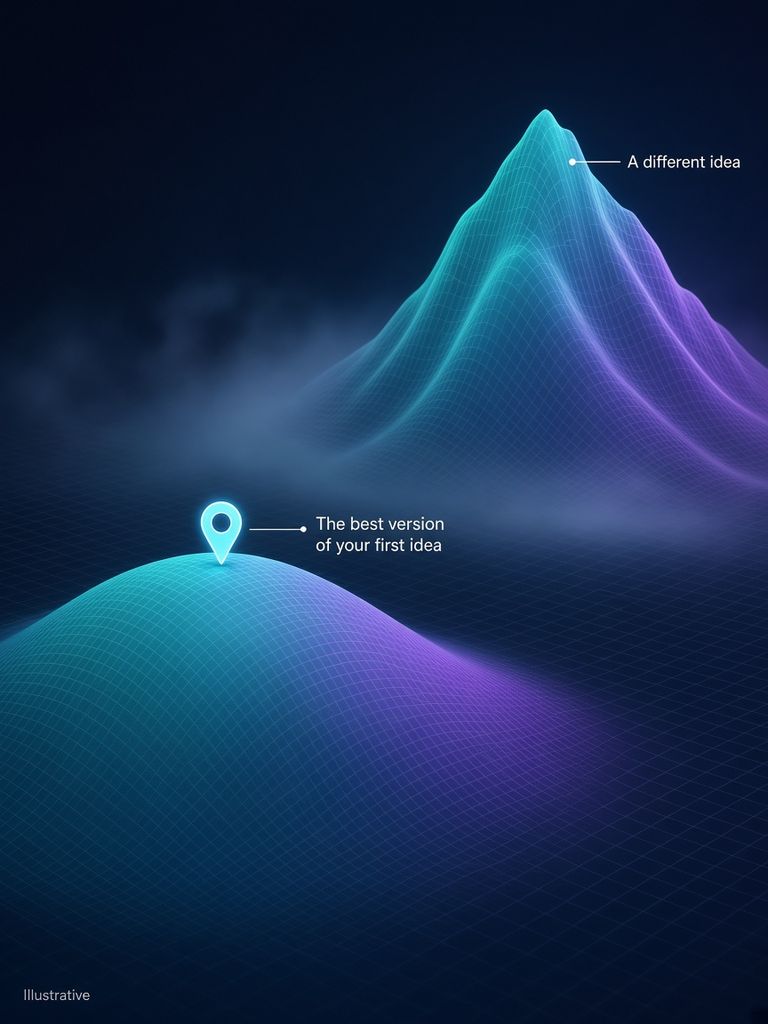
The small hill is where tweak-by-tweak testing settles. The tall peak is a different idea, not a better tweak. Illustrative.
Here is how a site ends up on the small hill.
You optimize by tweaking. Button color, a word in the headline, the order of two bullets. Each tweak is a small step. Small steps are exactly gradient descent: they find the top of whatever hill you started on.
Your starting point was an accident. The first version of the page was whatever the founder or the agency wrote at launch. Every test since has been a nudge from there. You never checked whether a completely different angle lives on a taller hill.
Tests that lose get reverted, so you stop wandering. If a bold rewrite tests worse in week one, it gets pulled. Sometimes that is right. Sometimes it was a better idea that needed a few more visitors, or one more revision, and you walked back up the small hill.
The steps are graded alone. A headline that is best on its own can be the worst match for the button next to it. Optimizing one piece at a time can lock in a combination that is a local peak for each piece and bad for the page.
The tell is familiar: a year of tests, a pile of "flat" results, and a conversion rate that hasn't moved in months. That is not proof you are at the top. It is proof you are at the top of your hill.
Alex Hormozi doesn't guess which ad will win
Alex Hormozi runs one of the most-watched business channels around, and his ads are not guesses. He posts a lot of organic content, lets the audience vote with views and engagement, and turns the winners into paid ads. Here he is on how that works:
Read that through the landscape picture and it is a search strategy. Every organic post is a cheap step to a new spot on the map. Most land on low ground. A few land on a tall hill, and those are the ones that get a budget. He never has to know in advance which idea is best. He just has to try a lot of very different ideas cheaply and put money behind whatever the data says is winning.
That is the opposite of tweaking one ad until it stops improving. Tweaking finds the top of the hill you are on. Lots of cheap, different attempts find out which hill is tallest.
Most sites can't copy this directly. You don't have a feed of millions of people voting on your checkout page. But your visitors are voting on your copy, offers, and layouts every day, whether you count the votes or not. The trick is to put several different versions in front of them and let the votes move the traffic.
How Bandit helps you find the taller hill
You can't see your whole landscape either. Nobody can. What you can do is copy the tricks AI researchers use, and the playbook Hormozi runs on his content, on your own site: many different versions of your copy, offers, and layouts, a fair look for each, and traffic moved to the winner. That is what a bandit is built for.
It keeps exploring without you deciding to. Bandit uses Thompson sampling, which sends most traffic to the version that is converting best and keeps sending a share to the others while it is still unsure. That is the "random steps" trick, sized automatically: a lot of exploring when the evidence is thin, less as it firms up. A bold idea that starts slow still gets enough visitors to show what it can do instead of being reverted in week one. The exploration vs exploitation guide goes deeper on how that balance works.
It makes big jumps cheap. On a fixed 50/50 test, a wild idea that loses costs you half your traffic for weeks. In Bandit, a losing version loses traffic as soon as the evidence says so. That changes what is worth trying. You can put a completely different angle next to your control, a different promise, a different offer, a different page order, and the downside stays small. Those are the jumps that land you on a different hill.
It helps you start from more places. Starting from one launch-day page is a single walker on the map. AI variant drafts help you write alternatives that differ in message, not just wording, grounded in what is already converting on your site. More starting points, more chances one of them is on the tall hill.
It tests the page as a page. Whole-page experiments test every slot together and credit one payout to the full combination a visitor saw, so you aren't stuck with a headline and button that are each a local peak and a poor pair.
It notices when the hill moves. Your landscape isn't fixed. Seasons, prices, and competitors reshape it, and yesterday's peak can sink. With forgetting turned on, old results fade, Bandit grows less sure, and it starts exploring again instead of camping on a peak that is no longer there.
Warning
No tool can promise you the global best. The map is too big and nobody can see it. What Bandit changes is the odds: more ideas get a fair look, losing ideas cost less, and traffic keeps moving toward whatever is winning right now.
What to do this week
- Look at your last ten tests. If most were small wording tweaks, you have been climbing one hill.
- Write one alternative that changes the idea, not the words. A different main promise, a different first thing the visitor sees, a different offer. If it would make your team a little nervous, it is probably far enough away.
- Run it next to your control in Bandit, along with one or two other big swings. Let the bandit decide how much traffic each one earns.
- Don't revert a bold version by hand in week one. If it is truly worse, Bandit will stop sending it traffic for you.
- Turn on forgetting for experiments that will run for months, so the bandit keeps checking whether the peak has moved.
A local minimum is just a place where small steps stop working. The way out has always been the same, for AI and for your homepage: try some bigger steps, and make them cheap enough to take.
Bandit runs Thompson sampling on every experiment and keeps traffic flowing toward what converts while it keeps looking. Start a 30-day trial; no charge until day 31.
Ready to try algorithmic testing?
Stop wasting traffic on losing variants. Bandit's multi-armed bandit algorithms automatically shift traffic to your best-performing treatments in real time.
Try it on my site