The thumbnail is the pitch
In December 2017 Netflix's engineering team published Artwork Personalization at Netflix. Their question wasn't which title to recommend. It was how to convince you a title is worth watching. Their answer: the artwork. In their words, if the image captures something compelling to you, it "acts as a gateway into that title."
Netflix had already used multi-armed bandits to find the single best image for each title across all members. The 2017 work went a step further: pick the best image for each member, using a contextual bandit that learns from what people actually play.
The examples in the post stick. Someone who has watched many romantic movies might be drawn to Good Will Hunting by artwork of Matt Damon and Minnie Driver; someone who watches comedies might respond to Robin Williams. A fan of Uma Thurman gets her on the Pulp Fiction artwork, a John Travolta fan gets him. The film is the same. Each viewer gets a different pitch for it, or as Netflix put it, "over a 100 million different products with one for each of our members."
It worked. Netflix A/B tested personalized artwork against the single-best-image bandit, saw "a significant lift in our core metrics," and rolled it out to everyone.
Swap "title" for "your product" and "artwork" for "the first screen of your page", and you have the problem every marketing team has. You just don't usually have Netflix's tooling.
Note
We have no connection to Netflix. This post summarizes the ideas from their public write-up and applies them to marketing pages. Read the original for the specifics of their system.
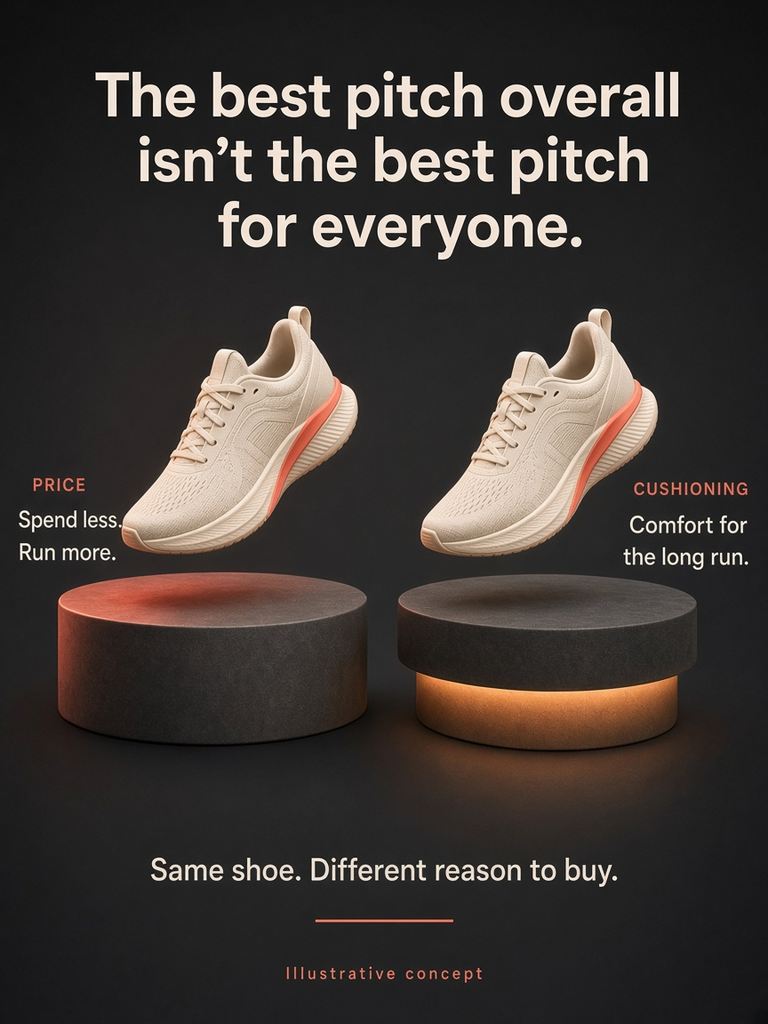
Same product, two pitches. Netflix does this with artwork; your landing page can do it with headline and offer. Illustrative.
Your hero section is artwork
Every page that asks for something has a "thumbnail": the few elements a visitor takes in before deciding to stay or leave.
On Netflix
- Title = a show or film
- Artwork = the image on the row
- Play = the reward
- Member history = context
On your site
- Title = your product or offer
- Artwork = headline, hero image, CTA
- Purchase, signup, booked demo = the reward
- Source, device, campaign, region = context
A few places this shows up:
- Landing pages. A visitor from a "cheap running shoes" ad and a visitor from a marathon-training newsletter land on the same product. One wants the price in the headline, the other wants the cushioning spec.
- Checkout. Free-shipping messaging, a guarantee badge, a payment-plan line, or nothing at all. Which reassurance closes the sale depends on who is buying and what they are worried about.
- Demo booking. "See it in 20 minutes" and "Talk to an engineer" are two pitches for the same calendar slot. A founder on a phone and a procurement lead on a desktop rarely respond to the same one.
- Email. A subject line is the artwork in someone's inbox.
Point 1: picking one winner for everyone leaves money behind
The usual playbook is to A/B test two headlines, find that B wins by 4%, and ship B to everyone. Netflix's post is a polite argument against that habit. A single winner is the best compromise across all your visitors, which means it is the wrong choice for whichever groups prefer the loser.
If 30% of your traffic converts better on A, shipping B to everyone throws away that lift on 30% of your traffic, for good. We wrote about this in more detail in Your Facebook Visitors and Your Email List Are Not the Same Person.
Point 2: learn while you serve, not after
Netflix describes its usual process: collect a batch of data, train a model, A/B test it, roll out the winner. Their verdict is that this "batch approach incurs regret: many members over a long period of time did not benefit from the better experience." So for artwork they moved to online learning with contextual bandits, which shift toward what works as evidence arrives instead of waiting for a test to end.
That matters more for you than for Netflix. Netflix notes that with over a hundred million members, the cost of exploring is "amortized across our large member base." A store doing a few thousand sessions a day can't spread that cost so thin, so it can't afford to spend a month sending half its checkout traffic to a losing badge. See Exploration vs. Exploitation for how that trade-off works.
Point 3: context is what makes it personal
A plain bandit learns one winner and converges on it. A contextual bandit learns which option wins for whom. Netflix's list of signals includes viewing history and genres, but also country, language, device, time of day and day of week. They also stress that they don't hand-write rules like "comedy fans get Robin Williams"; they "rely on the data to tell us what signals to use."
Their most useful finding for marketers: personalization helped most "where the member had no prior interaction with the title," because artwork matters more when a title is unfamiliar. That's a first-time visitor to your landing page. You don't have their history, but you have plenty at the moment they arrive:
Traffic source and campaign
A paid-social click, an organic search and a newsletter reader want different things.
Device
Mobile visitors often respond to shorter copy and a simpler ask.
Region
Shipping, currency and seasonal messaging change by location.
Survey answers
One question ('What brings you here?') is cheap context with a lot of signal.
Deep personal history
Most of your visitors are new. Don't plan around data you won't have.
Point 4: credit the pitch for the outcome it caused
Netflix scored artwork on "quality plays," and chose labels by "looking at the quality of engagement to avoid learning a model that recommends 'clickbait' images: ones that entice a member to start playing but ultimately result in low-quality engagement."
They also kept each member's image from changing too often, so engagement could be attributed to a specific image. Bandit does the same: a visitor keeps the version they were assigned, so a later purchase is credited to the version they actually saw.
The marketing version: a landing headline that raises add-to-cart but lowers completed purchases is losing. A demo-page CTA that books more calls that never show up is losing. Reward the outcome you're paid for, at the end of the funnel. That's why Bandit scores funnel experiments on the final conversion, and can score on margin rather than raw order count.
Point 5: the algorithm can only choose from what you give it
The Netflix post is open about this: personalization needs "a good pool of artwork for each title," diverse enough "to cover a wide potential audience interested in different aspects of the content." Their artists design images that differ in theme and aesthetic, with the selection algorithm in mind.
The same goes for your variants. Three headlines that differ by a single adjective give the algorithm nothing to learn from. Write options that make different arguments: price, outcome, proof, speed. If writing them is the bottleneck, Bandit's AI drafts write new options from your page and from how the current ones are doing.
Where the analogy breaks
Borrowing credibility should be honest about the differences:
- Traffic. Netflix says exploration "would be less suitable if the cost of exploration were high." With less traffic, each visitor spent exploring costs you more. Contextual personalization also needs enough visitors in each group to tell the options apart. Do what Netflix did: start with a plain bandit that finds one winner, and add context once the data supports it. Bandit does this by default. Experiments start as plain bandits and move to contextual bandits once you have enough traffic.
- Logged-in history. Netflix knows what you watched last night. Most of your visitors are anonymous on their first visit, so your context is shallower and arrives at the door.
- Engineering team. Netflix's system handles a peak of over 20 million requests per second and has a research team behind it. You shouldn't need one.
How to do this without Netflix's team
This is what Bandit is for. Pick an element on your page, such as a headline, hero image, CTA or checkout badge, write the alternatives, and pick the goal: a purchase, a signup, a booked demo. Bandit serves each visitor one version and moves traffic toward what converts as results come in.
When an experiment has enough history and Bandit sees that different visitor groups respond differently, it can be upgraded to contextual, so it learns which version wins by device, region, survey answer or audience rather than one winner for everyone.
Netflix decided the image on a row was too important to leave as one choice for everyone. Your headline, your checkout and your demo page are your versions of that image.
Ready to try algorithmic testing?
Stop wasting traffic on losing variants. Bandit's multi-armed bandit algorithms automatically shift traffic to your best-performing treatments in real time.
Try it on my site